
Sustainability report
under VS and GRI.
For companies in Austria with 250 to 1,000 employees that customers, banks or insurers ask for sustainability information, or that want to report under the Voluntary Standard (VS) or GRI.
You enter each value with evidence, a second person reviews it, and at the end you export the report as PDF, DOCX and XBRL.
- 250 to 1,000 employees
- mid-sized companies above the EU SME threshold
- Customers, banks, insurers
- ask for information in the value chain
- Austria
- Environment Agency Austria factors, § 243b UGB
- VS under Delegated Regulation (EU) 2026/1560
- GRI with content index
- Scope 1 and 2
- PDF, DOCX and XBRL
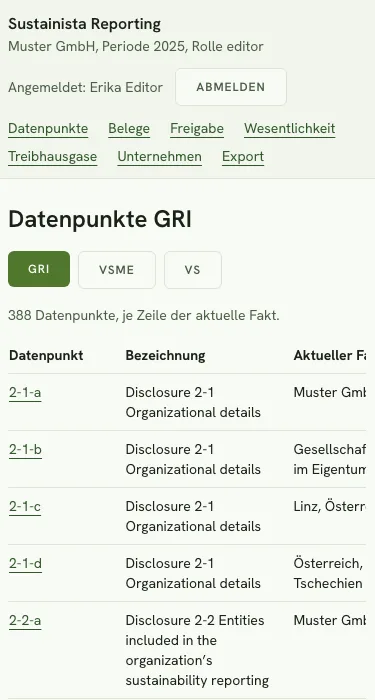
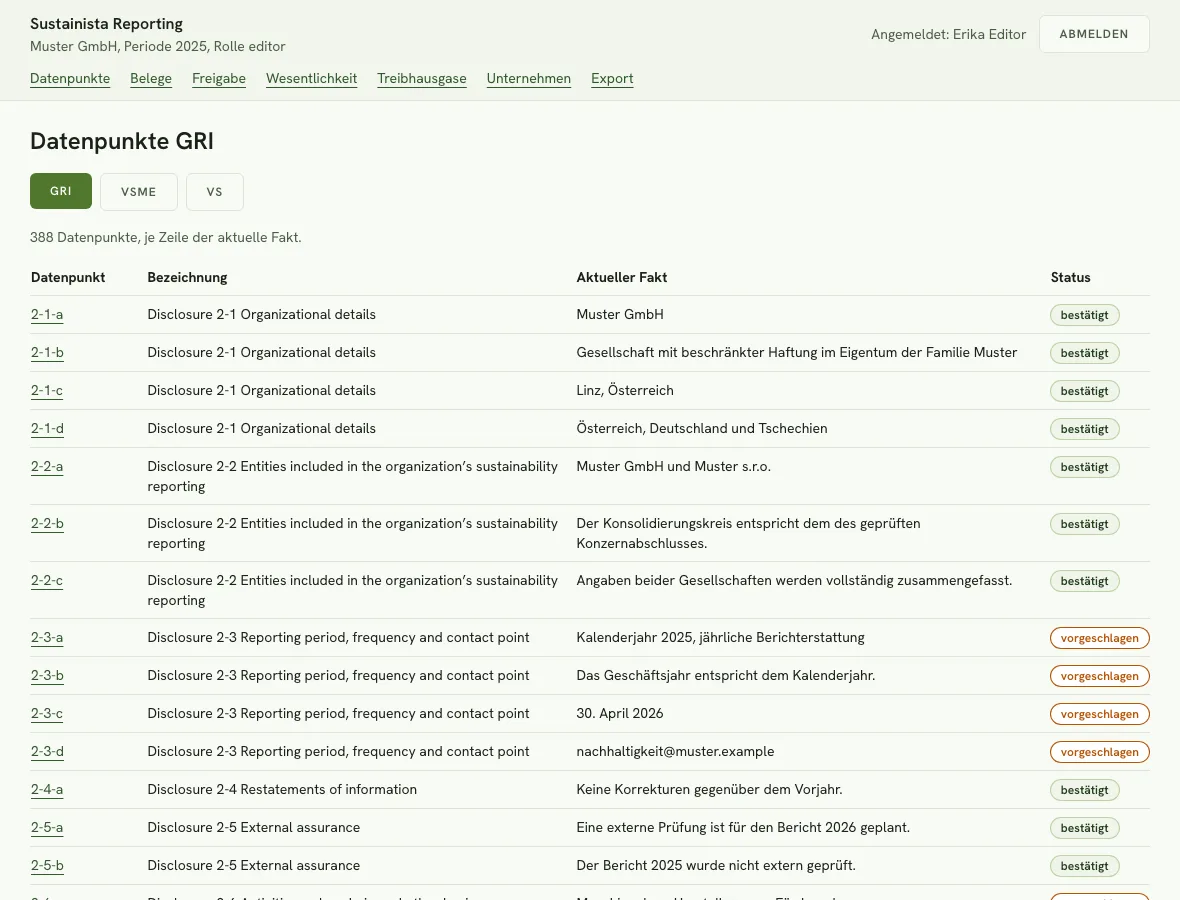
Benefits
Answer requests,
keep the evidence at hand.
One answer for customers and banks
Customers and banks ask for sustainability information, for example about the workforce. A report under the Voluntary Standard (VS) or GRI answers with value and evidence. Example from the demo data: 398 permanent employees on 31.12.2025, according to the personnel statistics.
Two standards in one place
Evidence, greenhouse gases and materiality live in the same software. Release check and export exist for VS and for GRI.
Evidence for a later audit
For every confirmed value an auditor sees evidence, location and quote, and who proposed and confirmed it. Example: management with two members and advisory board with three members, evidence Organigramm_2025.pdf, page 1.
Steps
Six steps
to the report.
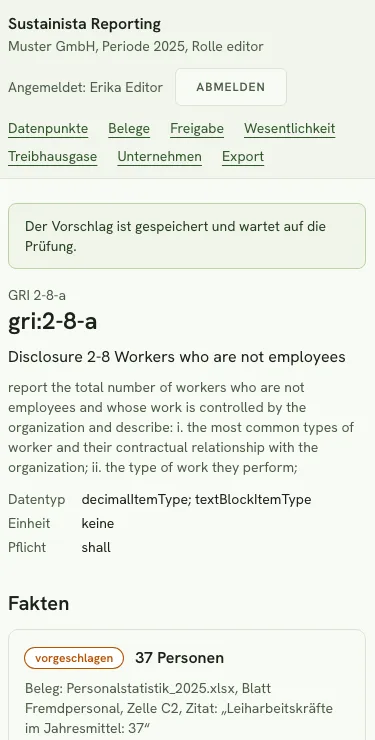
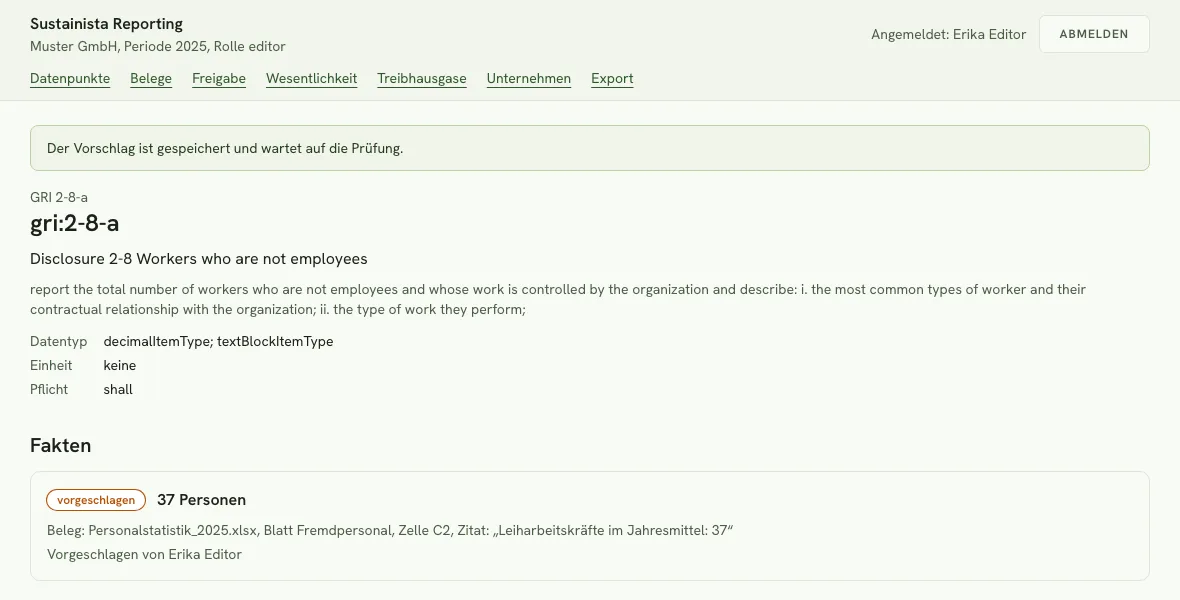
All images come from the software. The data belongs to the fictitious Muster GmbH.
Enter values, with evidence
You enter a value and upload the evidence. You add the location in the document and a quote.
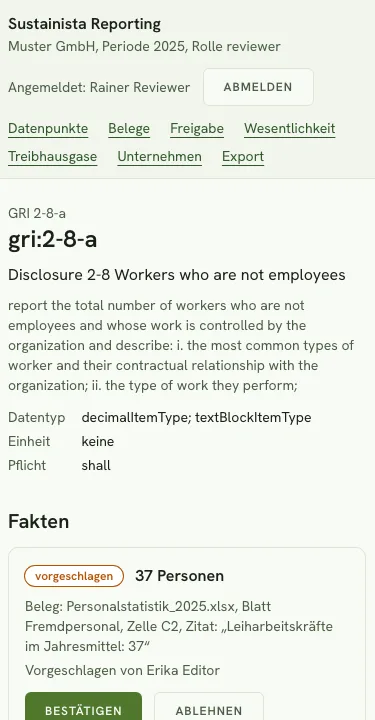
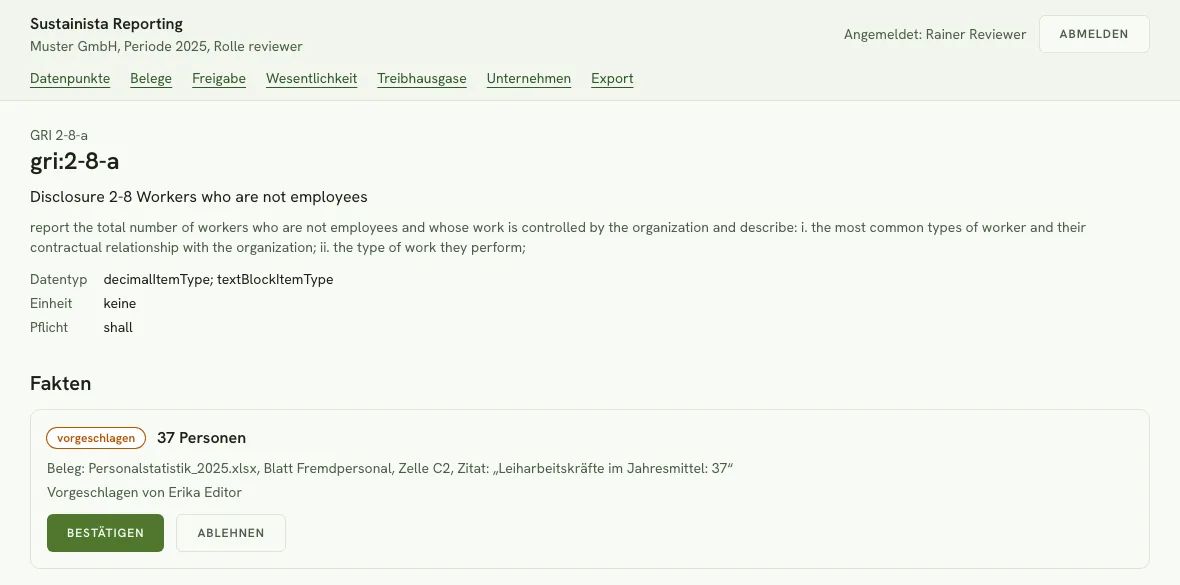
Example from the demo data: 37 temporary workers, evidence Personalstatistik_2025.xlsx, sheet Fremdpersonal, cell C2.
Four-eyes review
An entered value is only a proposal at first. Only a person with the reviewer or administrator role can confirm or reject it.
The software stores who proposed the value and who confirmed it.
Calculate greenhouse gases
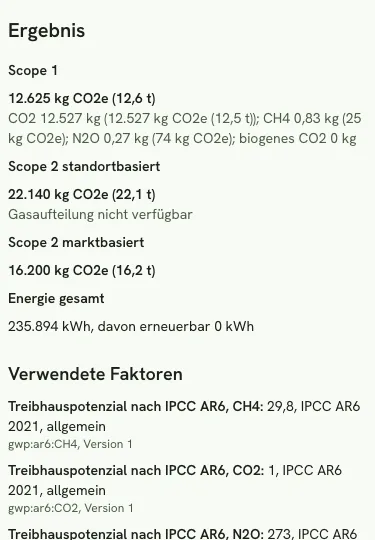
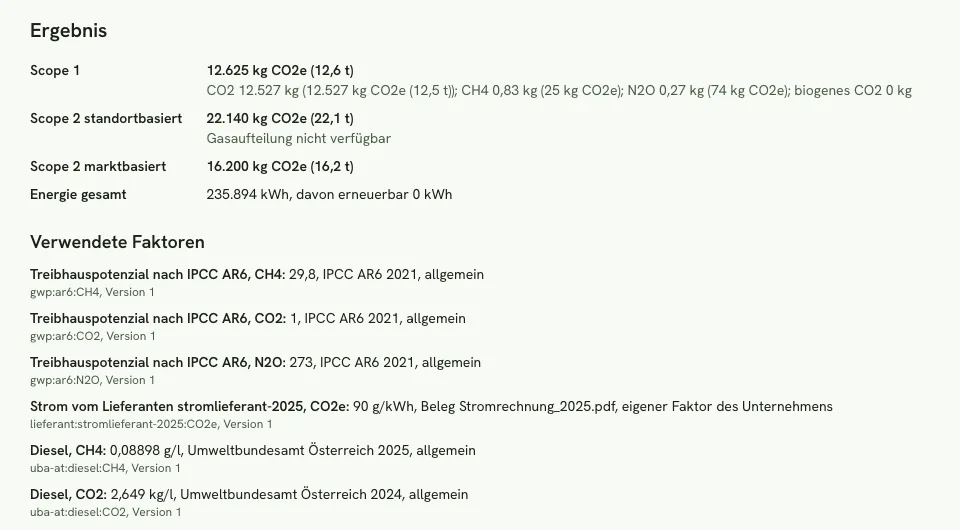
You enter consumption, for example litres of diesel, cubic metres of natural gas and kilowatt hours of electricity. The software calculates Scope 1 and Scope 2, location-based and market-based.
It uses the factors of the Environment Agency Austria (Umweltbundesamt) and the global warming potentials from IPCC AR6. Every factor appears in the result with its source and version.
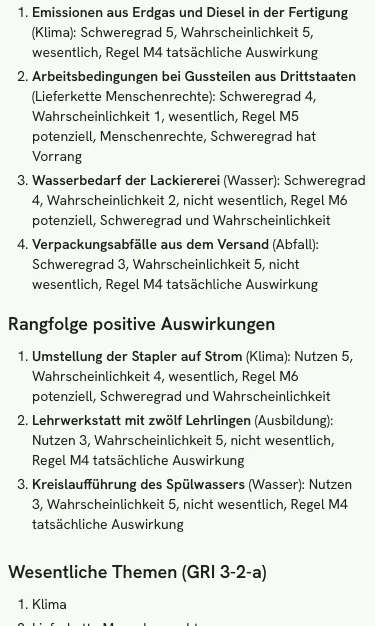
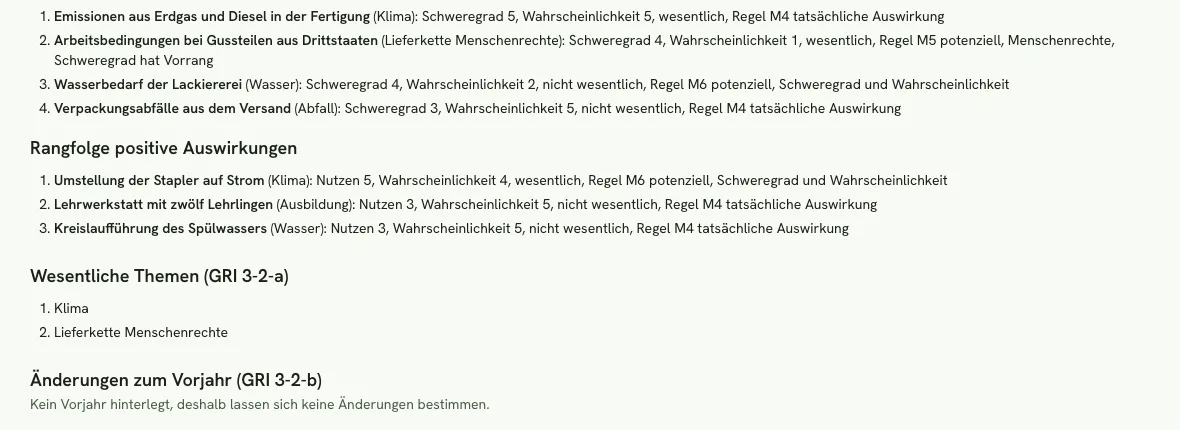
Materiality under GRI 3
You record the impacts of your company and rate severity and likelihood. The software ranks them and shows which topics are material.
You transfer the material topics to the report with one click. In the demo data these are climate and human rights in the supply chain.
Release check
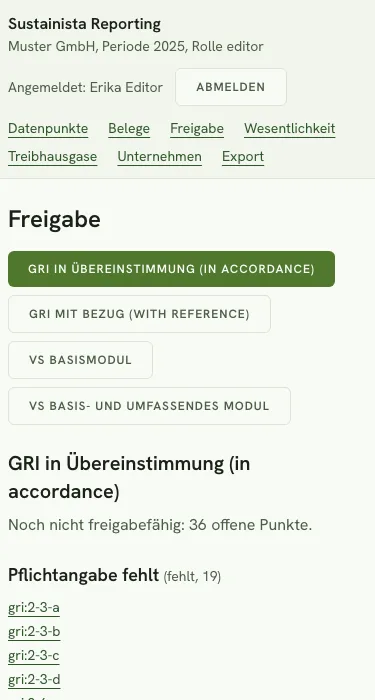
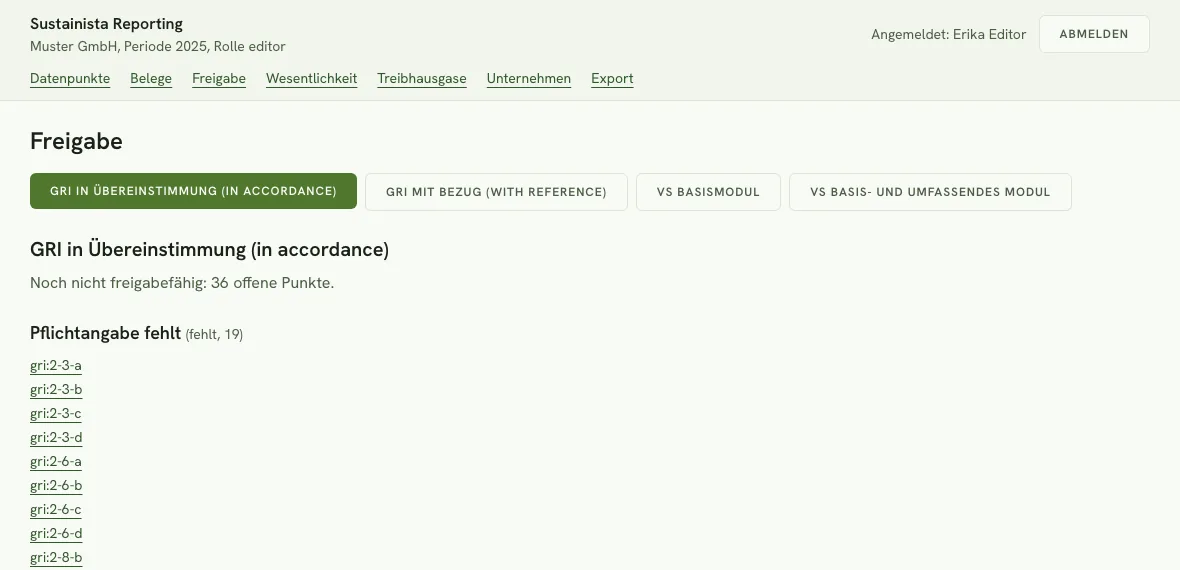
Before export the software checks every required disclosure. Open items appear in a list, such as a missing disclosure or a proposal nobody has reviewed yet.
The report can only be released once every required disclosure is met or omitted with a reason.
Export
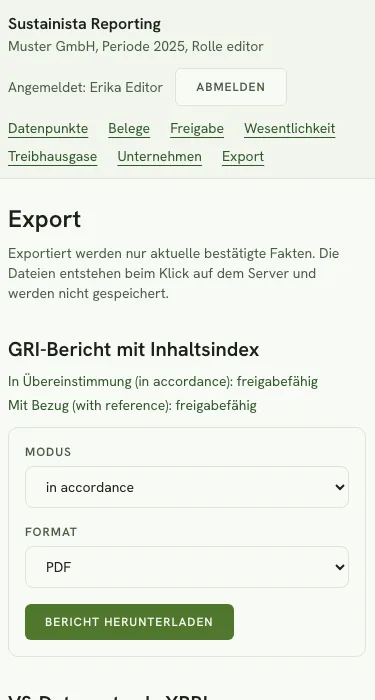
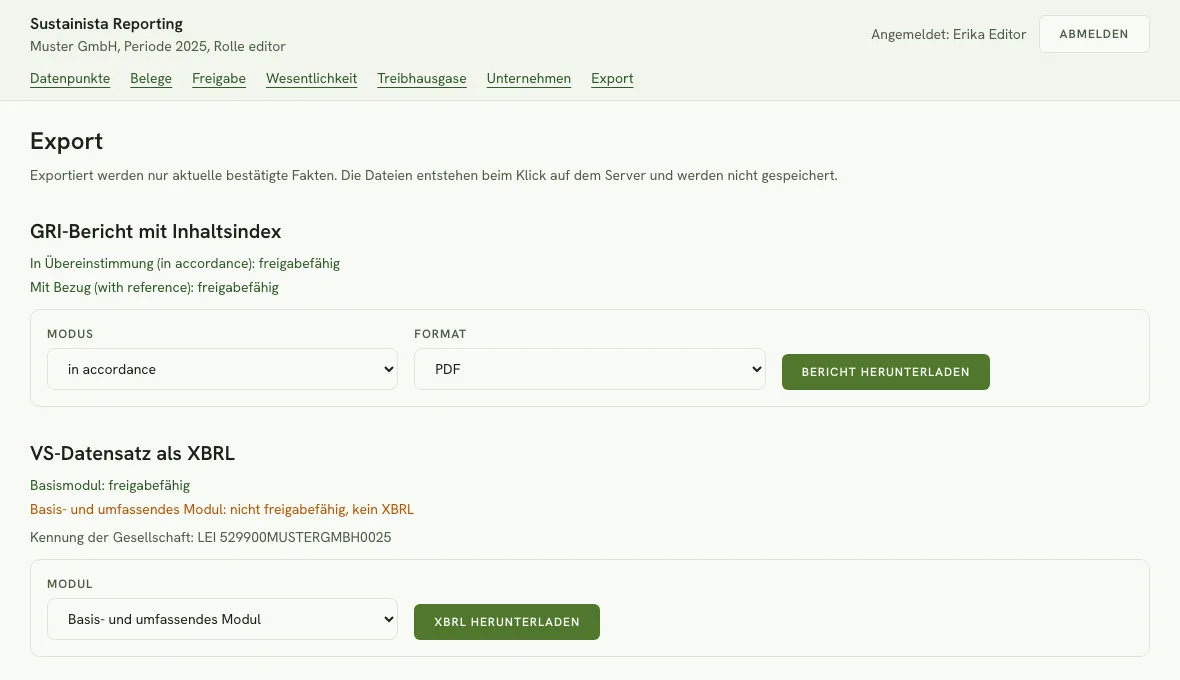
The report is produced as PDF and DOCX, with a GRI content index. The software outputs the VS data set as XBRL under the VSME taxonomy, validated against the taxonomy.
Only confirmed values go into the export.
Standards and outputs
Named precisely.
No umbrella terms.
- VS basic module
- Voluntary Standard under Delegated Regulation (EU) 2026/1560, basic module.
- VS basic and comprehensive module
- The same standard with the additional module. The release check covers both options.
- GRI Universal Standards
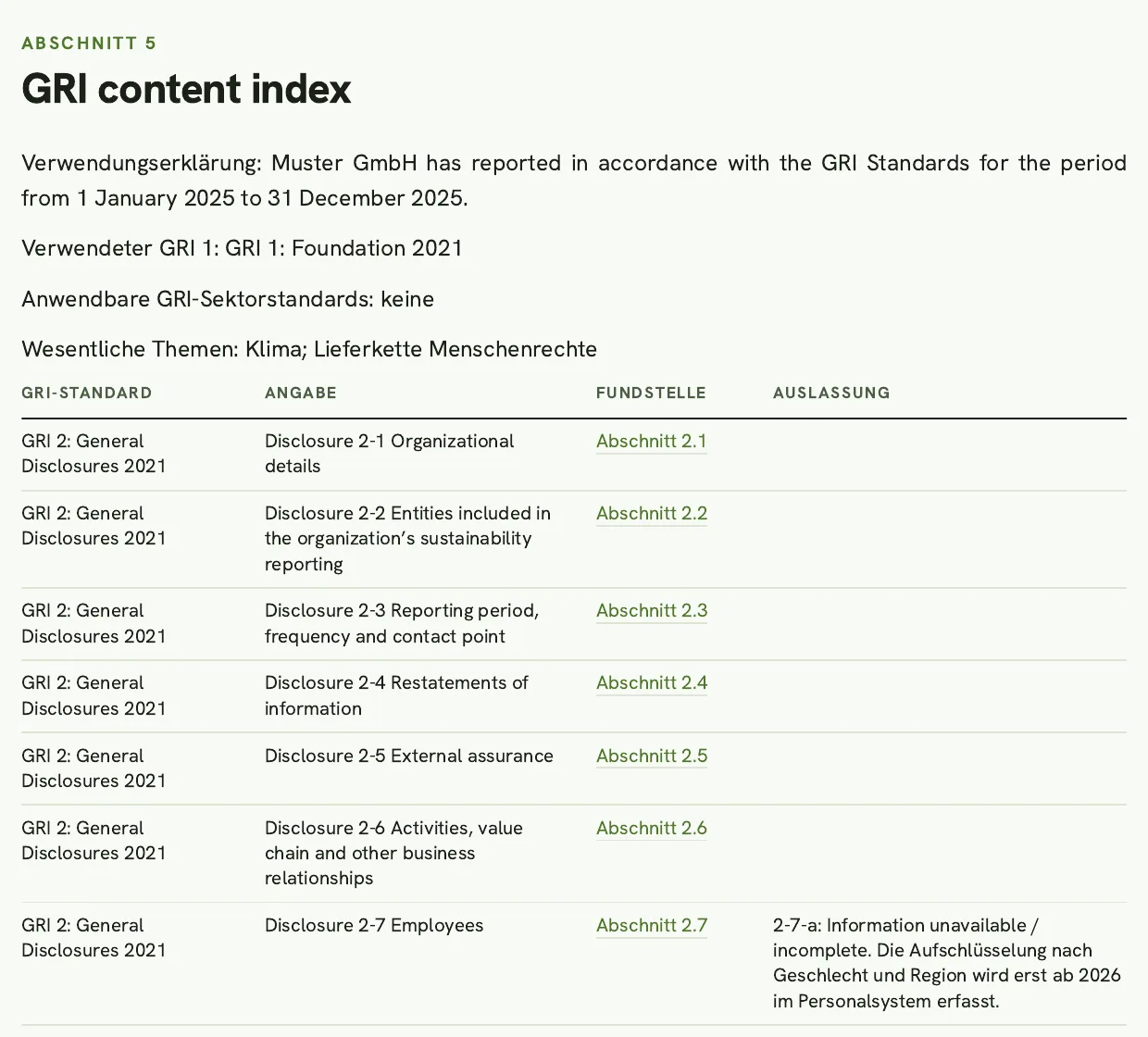
- Reporting in accordance with or with reference to the GRI Standards, each with a GRI content index.
- GRI 3
- Materiality assessment with a ranking of impacts and a list of material topics.
- Scope 1 and Scope 2
- Location-based and market-based. Factors of the Environment Agency Austria, global warming potentials from IPCC AR6.
- PDF and DOCX
- The report with evidence as footnotes and the GRI content index.
- XBRL
- The VS data set under the VSME taxonomy, validated against the taxonomy.
Limits
What the software
does not do.
So you know where you stand.
- No Scope 3
- The software calculates Scope 1 and Scope 2. It does not calculate emissions from the supply chain or from the use of your products.
- No full ESRS report
- It supports the Voluntary Standard (VS) and GRI. It does not produce a report under the ESRS as required for companies subject to reporting.
- No reading of documents
- A person enters each value and attaches the evidence. The software does not read invoices or documents.
- No audit opinion
- Sustainista does not audit reports as an auditor and gives no audit opinion. Evidence, location and quote for each value are ready for an audit.
Traceability
Every value
has an origin.
Evidence and location
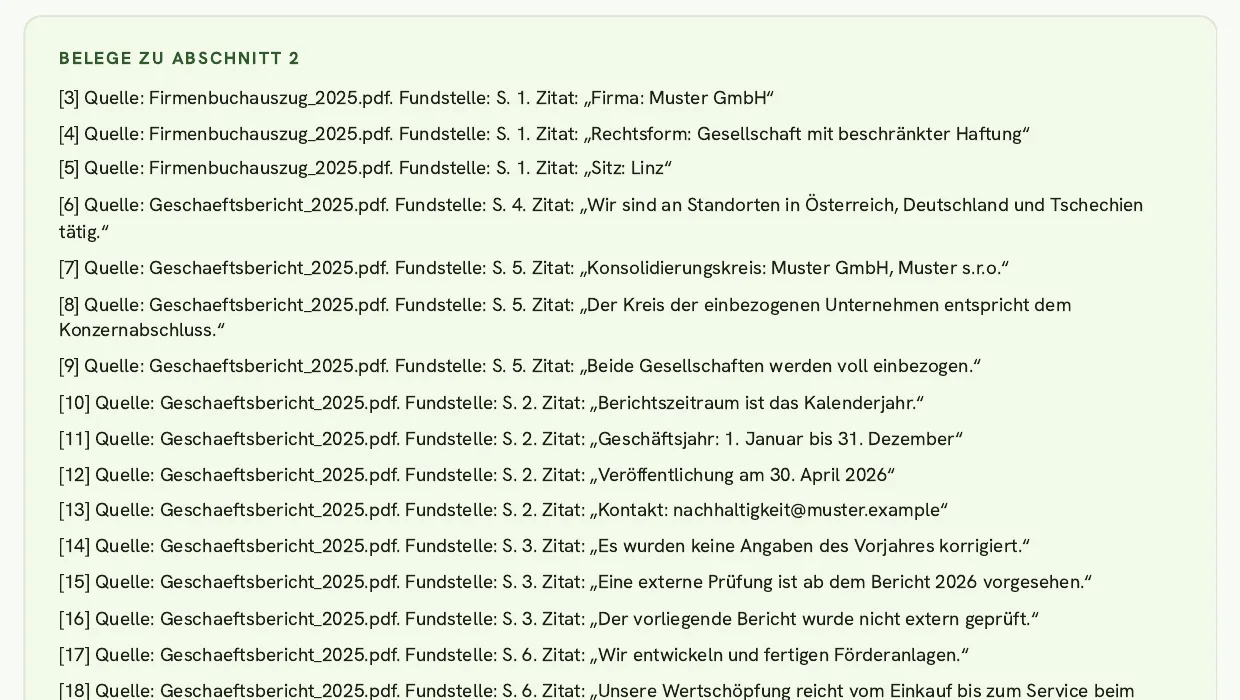
Every confirmed value has evidence, a location and a quote. In the PDF they appear as a footnote.
Nothing is overwritten
A stored value can be neither changed nor deleted. A correction is a new proposal. Once confirmed it replaces the old value, and the old value stays stored.
Who confirmed what
For every value it is recorded who proposed it and who confirmed or rejected it. The database sets these names itself.
Separate tenants
Each company is a separate tenant in the database. A person only sees the data of the companies they are a member of.
Quality
How we make sure
it is right.
Every part of the software is built against a written requirement. A second review, separate from the build, accepted it. Every review includes counter-checks: we build in errors on purpose, and the tests must find them.
23
legal facts checked before building
Thresholds, deadlines and legal acts, each with a source and a verbatim quote. Building started only afterwards.
388
GRI requirements recorded
From the texts of 34 GRI Standards. In addition 143 data points of the VSME taxonomy and 36 paragraphs from Annex I of the VS.
143
data points matched between VSME and VS
For every VSME data point it is recorded whether and where the VS requires it. The same for each of the 36 paragraphs of the VS.
33
factors with page reference
25 values of the Environment Agency Austria (19 emission factors and 6 energy contents) and 8 global warming potentials under IPCC AR6, each with PDF page and quote. A checking program compares every value with the page. In the counter-check it found all 146,108 deviations built in.
0
errors in the XBRL export
Checked with Arelle, a freely available XBRL validator, against the EFRAG VSME taxonomy: 0 errors, 0 inconsistencies.
621
database tests
Among other things they check permissions, separate tenants, the four-eyes review and the versions of values. All 621 pass.
Found and fixed
- Two requirements were missing from the GRI catalogue (303-4-b and 306-5-d). The second review found them; they have been added.
- A value could count twice in the report after a rejection. This is fixed and secured by a test.
- A person who proposed a value and was also a reviewer could confirm their own proposal. Today the database refuses this.
Legal situation
What applies,
in brief.
Status of the law
Last checked in November 2026. If the law changes, we review the consequences and adapt the software and this page. Not legal advice.
18 Mar 2026
Omnibus I in force
Directive (EU) 2026/470. Only companies with more than 1,000 employees and a net turnover of more than 450 million euros have to report.
2026
Voluntary Standard (VS)
Delegated Regulation (EU) 2026/1560 with a basic and a comprehensive module. Open to all companies without a reporting obligation.
Today in Austria
§ 243b UGB
Covers large public-interest entities with more than 500 employees. Under § 908 (2a) UGB a company is exempt if its turnover is up to 450 million euros or it has no more than 1,000 employees.
19 Mar 2027
Transposition of Omnibus I
By this date Member States must transpose Omnibus I into national law.
From financial year 2027
Limit on requests in the value chain
From partners with up to 1,000 employees, reporting companies may only request the information in Annex II of the VS (Art. 3). In Austria § 243ba UGB currently refers to the VSME Recommendation (EU) 2025/1710.
Sources
What the software
is based on.
Every rule and every factor in the software goes back to one of these sources. The links lead to the source or to an official overview.
EU law
Directive (EU) 2026/470 (Omnibus I)
Amends the CSRD: only companies with more than 1,000 employees and a net turnover of more than 450 million euros have to report. Overview by the European Securities and Markets Authority (ESMA).
EU law
Delegated Regulation (EU) 2026/1560 (Voluntary Standard VS)
Commission version and annexes: Annex I with the basic and the comprehensive module, Annex II with the limit on requests in the value chain.
Commission version C(2026) 5011 of 03.07.2026 (PDF)Annexes to the Commission version (PDF)
EU law
Recommendation (EU) 2025/1710 (VSME)
Commission recommendation on the voluntary SME standard VSME. Since the VS entered into force on 24.09.2026 it no longer has legal effect; in Austria § 243ba UGB still refers to its Annex I.
Austrian law
§ 243b UGB (Sustainability Reporting Act, BGBl. I Nr. 6/2026)
Sustainability statement under § 243b UGB, limit on requests under § 243ba UGB, transitional provision § 908 (2a) UGB.
Standard
GRI Universal Standards 2021
GRI 1: Foundation 2021, GRI 2: General Disclosures 2021 and GRI 3: Material Topics 2021, the basis for content index, release check and materiality assessment.
Data
Emission factors of the Environment Agency Austria
Austria's National Inventory Document 2026 (REP-1031) and the harmonised Austrian direct and upstream GHG emission factors for relevant energy carriers and technologies, data status 2025 (REP-0989).
Data
Global warming potentials from IPCC AR6
IPCC Sixth Assessment Report, Working Group I, Chapter 7, Table 7.15, and Supplementary Material, Table 7.SM.7.
Format
EFRAG VSME XBRL taxonomy (version 2026-05-01)
The basis for exporting the VS data set as XBRL; the export is validated against this taxonomy.
Professional background
Who is behind
Sustainista.
Dr. Stefan Bauer
Founder and Managing Director of Sustainista GmbH, Vienna
More than 15 years of experience at the intersection of technology, innovation and sustainability: as a researcher, strategy consultant and entrepreneur.
He is responsible for the content quality of every project and works directly with management teams.
Silke Herrnreiter
ESG and Sustainability Strategy Expert
ESG strategy, sustainability reporting and corporate transformation.
Sara Safavirad
ESG and Compliance Expert
ESG regulation, CSRD and sustainable finance.
Sustainista GmbH, FN 576551 w, Commercial Court Vienna.
More about the teamWorking together
How we
work together.
01
Initial call and scope
We show the software with the demo data of Muster GmbH and clarify which standard and which package suit you.
02
Setup with your data
We set up a separate tenant for your company, with your reporting period and the roles for entering and reviewing.
03
Report with support
You enter the values with evidence. In the package with support we help you and present the results.
04
Release and export
The release check shows what is still missing. Then you export the report as PDF and DOCX and the VS data set as XBRL.
The presentation walks through software, sources, limits and working together in 17 slides. View presentation
What you bring
The documents
we usually need.
The list comes from the evidence of the sample report of Muster GmbH. What is needed depends on the standard.
- Company register extract
- Company name, legal form and registered office.
- Annual report
- Sites, scope of consolidation, reporting period and strategy.
- Personnel statistics
- Employees at the reporting date and temporary workers.
- Organisation chart
- Management, supervision and who is responsible for sustainability.
- Code of conduct and supplier code
- Principles and reporting channels.
- Consumption figures
- Diesel in litres, natural gas in cubic metres, electricity in kilowatt hours, for example from a greenhouse gas statement.
- Electricity bill
- With your supplier's electricity disclosure, for market-based Scope 2.
- Materiality documents
- For example the minutes of a workshop, if available.
Packages
Three packages,
price on request.
All packages include the software with evidence per value, four-eyes review and release check. They differ in the standards and in the support from Sustainista.
Basic
Report under the Voluntary Standard.
For companies that want to answer requests from customers and banks with a report under the VS.
- VS basic module under Delegated Regulation (EU) 2026/1560
- Values with evidence, location and quote
- Roles for entering and reviewing
- Scope 1 and 2, location-based and market-based
- Release check for the basic module
- VS data set as XBRL under the VSME taxonomy
Price on request
Request a quoteVS and GRI
Both standards in one software.
For companies that also report under GRI or need the comprehensive module of the VS.
- Everything in Basic
- VS basic and comprehensive module
- GRI in accordance or with reference, with content index
- Materiality assessment under GRI 3
- Report as PDF and DOCX with evidence as footnotes
Price on request
Request a quoteWith support
Software and consulting from Sustainista.
For companies without their own sustainability team.
- Everything in VS and GRI
- Initial call and agreement on scope
- Presentation of results and feedback round
- Action plan with priorities from the carbon accounts
Price on request
Request a quoteWe clarify which package fits in the initial call.
We state the price with the quote, matched to standards, scope and support.
Sample report
Sample report
by email.
A sustainability report of the fictitious Muster GmbH under GRI, as PDF, with GRI content index and the evidence as footnotes. The report is in German.
All data is fictitious. Every page carries the watermark „Entwurf“ (draft).
FAQ
Frequently asked questions
For companies with 250 to 1,000 employees. They want to report under the Voluntary Standard (VS) or GRI. Or customers and banks ask them for this information.
Under Omnibus I (Directive (EU) 2026/470) only companies with more than 1,000 employees and a net turnover of more than 450 million euros have to report. In Austria § 243b UGB currently applies. It covers large public-interest entities with more than 500 employees. Under § 908 (2a) UGB a company is exempt if its turnover is up to 450 million euros or it has no more than 1,000 employees. Austria has to transpose Omnibus I by 19 March 2027.
The VS is the voluntary standard for sustainability reports under Delegated Regulation (EU) 2026/1560. It has a basic module and a comprehensive module. The software checks both options: the basic module alone or the basic and comprehensive modules together.
The report as PDF and DOCX, each with a GRI content index and the evidence as footnotes. In addition the VS data set as XBRL under the VSME taxonomy. The XBRL file is validated against the taxonomy.
It calculates Scope 1 and Scope 2, location-based and market-based. It uses the factors of the Environment Agency Austria and the global warming potentials from IPCC AR6. Every result names the factors used with source and version.
Only once every required disclosure is met or omitted with a reason. Until then the release check shows every open item with the data point concerned.
You create a new proposal. Once confirmed it replaces the old value. The old value stays stored. If the new proposal is rejected, the old value remains valid.
There are three packages: Basic with the VS basic module, VS and GRI with both standards, and a package with support from Sustainista. We state the price on request, together with the quote.
Yes. Use the form on this page to request the sample report of the fictitious Muster GmbH. You will receive it by email. All data is fictitious and every page carries the watermark „Entwurf“ (draft).
No. Each company is a separate tenant in the database. A person only sees the data of the companies they are a member of.
Read more
Related pages
Demo
Request
a demo.
We show you the software with the demo data of Muster GmbH, from the first value to the export.
Send us a short message. We will reply by email with a proposed date.